Muscles Used While Rowing: A Complete Guide
Rowing is one of the few exercises that engages nearly every major muscle group in a single movement. According to Concept2, the rowing stroke activates roughly 86% of the body's muscles. This guide breaks down exactly which muscles work during each phase of the stroke, how power is distributed, and how to maximize engagement through proper form.
Machine rowing demonstration showing the four phases of the stroke.
The Four Phases of the Rowing Stroke
Every rowing stroke consists of four distinct phases: Catch, Drive, Finish, and Recovery. Only the Drive phase produces propulsive force — the other three are about positioning, stability, and preparation. Understanding which muscles are active in each phase helps you focus your form and get the most from each stroke.
Catch
Power: ~0%The starting position. Your legs are compressed, shins vertical, arms extended. This is the preparation phase — no power is being generated yet, but several muscles are active to maintain the position.
Tibialis anterior · Hamstrings · Triceps
Abdominals · Forearm flexors
Drive
Power: ~100%The power phase. You push with your legs first, then swing your back, then pull with your arms. This is where all propulsive force is generated. The drive takes roughly 1/3 of the stroke cycle.
Quadriceps · Glutes · Hamstrings · Latissimus dorsi · Rhomboids · Biceps
Erector spinae · Trapezius · Deltoids · Forearm flexors · Calves · Abdominals
Finish
Power: ~0%The end of the pull. Your legs are fully extended, body leaned back slightly past vertical, and handle is drawn to the lower ribs. Muscles stabilize the body at peak extension.
Biceps · Rhomboids · Trapezius · Erector spinae
Deltoids (posterior) · Abdominals · Glutes · Quadriceps
Recovery
Power: ~0%The return to the catch. You extend your arms, hinge forward at the hips, then bend your knees to slide forward. This phase is about control and preparation — no propulsive work happens here.
Triceps · Abdominals · Hamstrings
Hip flexors · Tibialis anterior · Calves
Power Distribution: Legs, Back, Arms
The rowing drive is a sequential chain: legs first, then back, then arms. According to Concept2's force curve analysis, the ideal distribution is approximately:
This 60/30/10 split means your legs are the primary engine. Common beginners make the mistake of pulling too early with the arms, which wastes energy and reduces overall power output. The legs should initiate the drive, the back swings open once the legs are nearly extended, and the arms finish the pull last.
Muscle Group Breakdown
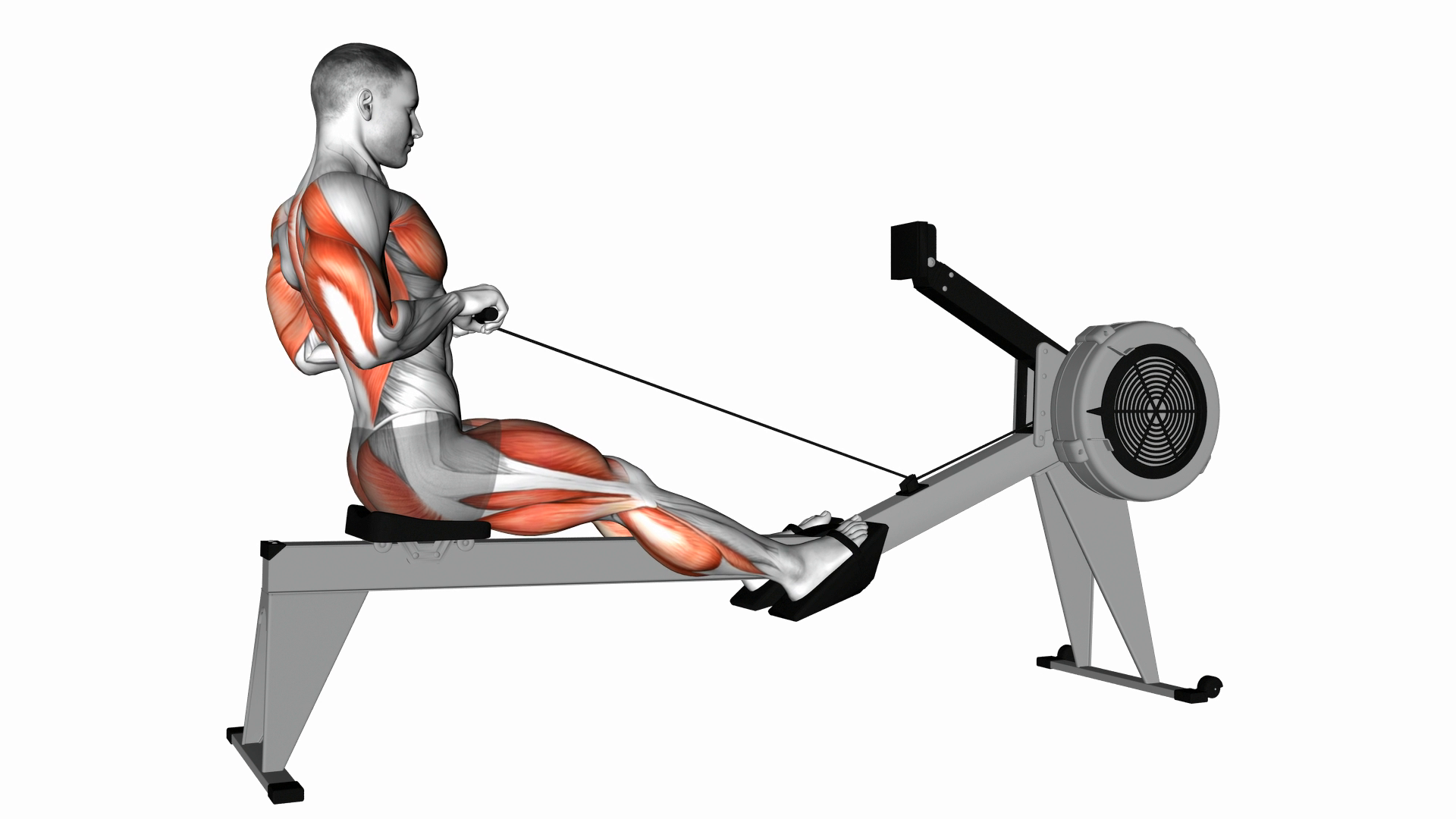
Major muscle groups engaged during the rowing stroke.
Lower Body (60% of power)
- Quadriceps — the primary leg extensors. They drive the initial push off the footplate during the catch-to-drive transition. The quads are the single most important muscle group in rowing.
- Hamstrings — work with the glutes to extend the hip during the drive and control the forward slide during recovery.
- Glutes — the largest muscles in the body. They provide hip extension power during the drive and stabilize the pelvis throughout the stroke.
- Calves (gastrocnemius and soleus) — stabilize the ankle against the footplate and assist with leg drive.
- Tibialis anterior — the shin muscle. It pulls the foot upward during the recovery to control the slide forward.
Core (part of the 30% back/core contribution)
- Rectus abdominis — flexes the trunk forward during recovery and stabilizes posture throughout.
- Obliques — resist rotation and maintain a stable trunk during the pull. Especially important for preventing side-to-side movement.
- Erector spinae — the lower back muscles. They extend the trunk during the drive phase and maintain an upright posture at the finish.
Upper Body (arms contribute ~10%, back ~20%)
- Latissimus dorsi — the largest back muscles. They initiate the arm pull by drawing the shoulder blades down and back. Heavily active in the second half of the drive.
- Trapezius and rhomboids — retract the shoulder blades at the finish position, contributing to a strong, stable pull.
- Deltoids — the posterior deltoids assist the lats during the pull. The anterior deltoids stabilize the shoulder during recovery.
- Biceps — flex the elbow to draw the handle to the body during the final phase of the drive.
- Triceps — extend the arms during recovery and help push the handle away from the body.
- Forearms and grip — maintain grip on the handle throughout the stroke. Grip fatigue is common during long steady-state sessions.
How Rowing Compares to Other Exercises
| Exercise | Primary Muscles | Body Coverage | Impact Level |
|---|---|---|---|
| Rowing | Legs, back, arms, core | ~86% of muscles | Low |
| Running | Quads, hamstrings, calves | ~40-50% of muscles | High |
| Cycling | Quads, glutes, hamstrings | ~35-45% of muscles | Very low |
| Swimming | Lats, shoulders, core, legs | ~70-80% of muscles | None |
Rowing stands out for combining high muscle engagement with low joint impact. Unlike running, your feet never leave the footplate, so there is zero ground impact. This makes rowing accessible for a wider range of fitness levels, including people who find running uncomfortable on their joints.
Tips to Maximize Muscle Engagement
- Drive with your legs first. Push the footplate away before your back opens or your arms pull. Think “legs, back, arms” as a sequence, not all at once.
- Keep your core braced. A stable core transfers power from your legs to the handle without energy leaking through a slouching torso.
- Pull the handle to your lower ribs, not your chin. Pulling too high shifts work from the lats to the smaller shoulder muscles, which fatigue faster.
- Use a relaxed grip. Over-gripping causes premature forearm fatigue. Hook your fingers over the handle rather than squeezing it.
- Control the recovery. Sliding forward too fast is wasted energy. The recovery should take about twice as long as the drive.
Frequently Asked Questions
Is rowing a full-body workout?
Yes. Rowing engages the legs (quads, hamstrings, glutes), core (abdominals, obliques, erector spinae), back (lats, traps, rhomboids), and arms (biceps, triceps, forearms) in every single stroke. It is one of the most complete exercises available on a single machine.
Does rowing build muscle?
Rowing primarily builds muscular endurance rather than hypertrophy (size). It can develop visible muscle tone in the legs, back, and arms with consistent training, but it is not a replacement for heavy resistance training if the goal is maximum muscle growth.
Which muscles does rowing work the most?
The quadriceps and glutes do the most work because the leg drive generates approximately 60% of the stroke's power. The latissimus dorsi (lats) is the most active upper body muscle.
Can rowing replace running for cardiovascular fitness?
For aerobic capacity, yes — rowing and running can produce similar cardiovascular adaptations. Rowing has the advantage of being low-impact and full-body, while running is more sport-specific for runners. Many athletes use rowing as a cross-training complement to running. For more on this, try our Erg-to-Run Equivalence Calculator.
How many calories does rowing burn compared to running?
At moderate intensity, rowing burns approximately 400-600 calories per hour, compared to 500-700 for running. The exact number depends on body weight and effort level. Our Calories Burned Calculator provides personalized estimates based on your specific data.
Related Content
- Stroke Efficiency Calculator — measure distance per stroke and technique metrics
- Rowing Performance Calculator — complete session analysis with power, split, and VO2max
- Calories Burned Calculator — personalized calorie estimates
- Concept2 Workout Guide — workout structure and technique tips
References
- Concept2: Muscles Used While Rowing — official muscle breakdown by stroke phase
- Concept2: Improving Your Rows with the Force Curve — power distribution data (60/30/10 legs/back/arms)
- NordicTrack: Muscles Rowing Machines Work — detailed 16-muscle breakdown
- Timing and Modulation of Activity in Lower Limb Muscles During Indoor Rowing (PMC) — electromyography study of muscle activation patterns